
Insights
Anyone Can Read a Balance Sheet Right?
Leiros ConsultingJuly 23, 20264 min read
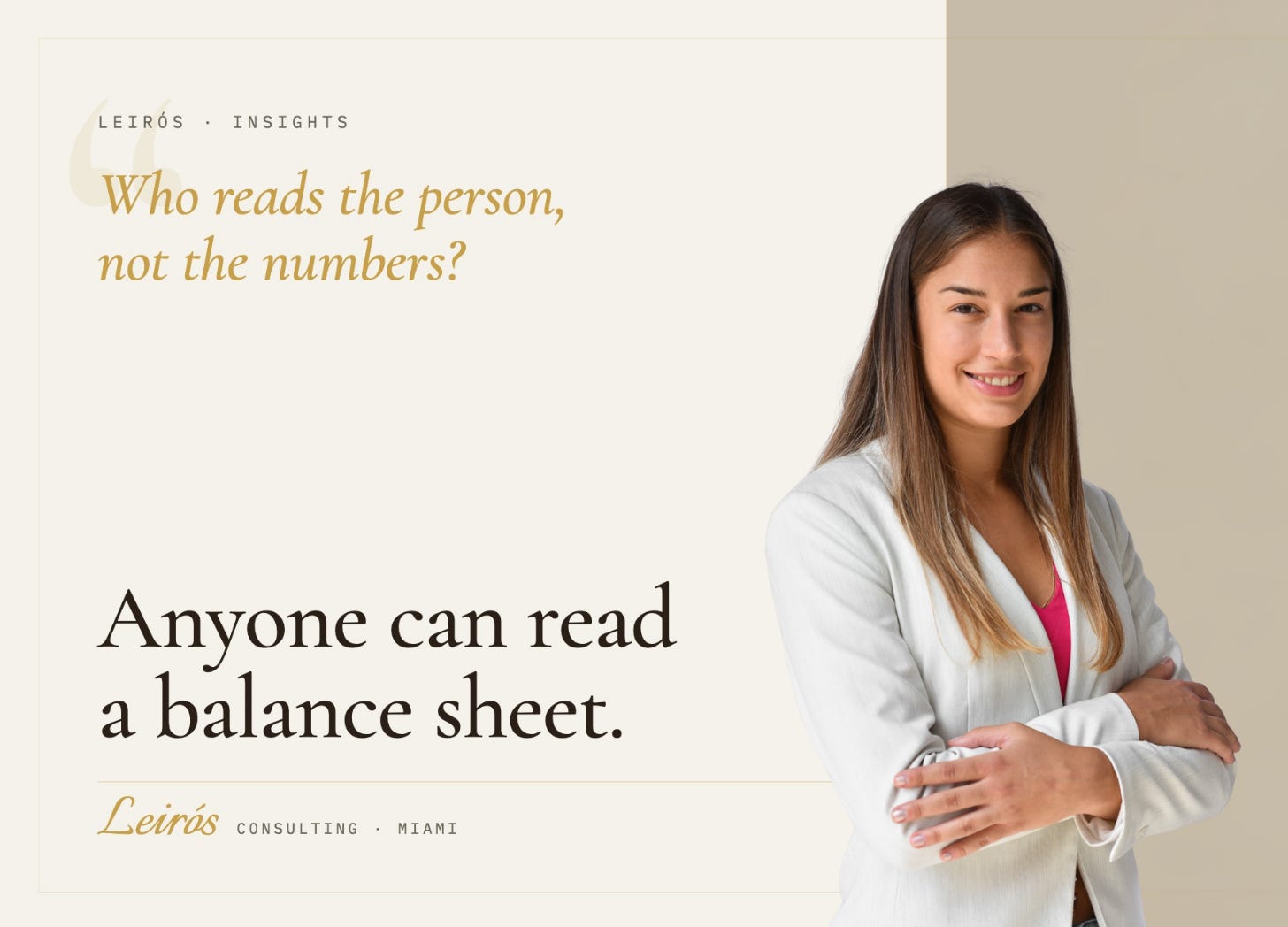
In twenty years of this work, the errors I remember were rarely about the numbers. A structure can be modeled. A tax exposure can be calculated. The thing that goes wrong, when something goes wrong, is almost always a sentence a client meant and did not quite say. He asks for one thing. He needs another. The gap between the two is where the money and the years disappear.
A founder tells me he wants a US company. On the surface that is a request about formation, and I could answer it in an afternoon. Underneath, the real question is usually somewhere else. Sometimes it is about his family, and what they inherit if he is not there to explain it. Sometimes it is about control, and who can reach what he has built if a deal turns bad. Reading which question a person is actually asking is the hardest part of this work, and it is the part no form has ever been able to do.
What Marija did, on her own
Last year, without anyone at the firm asking her to, Marija went and studied exactly that.
She spent seventeen months on it. Eight months at the elementary level of neuro-linguistic programming and practical psychology, then nine more at the master level, certified at both. One weekend a month, six hours on Saturday and six on Sunday, for a year and a half, on her own time and her own initiative. This was not a weekend seminar with a printed certificate at the end. The master level alone ran nine modules, and the ones that matter for the people we serve are the ones about how a person is built.
She studied metaprograms, which is the quiet reason two people can hear the same sentence and understand two different things. She studied how the mind stores an experience and how that storage can be changed. She studied the difference between the words a person chooses and the meaning underneath them, and how to listen for the second one. She learned to recognize the pattern in how someone communicates, to build rapport before building anything else, and to hear the concern a person has not said out loud.
What it changes in the room
Take the simplest version of what that does in a room. Two people arrive with nearly the same balance sheet and the same goal, and each hears me say one true thing, that how they hold a US asset decides what their family keeps. One leans in and wants every detail before he will move. The other has heard enough after a sentence and needs the room to slow down. Reading which of them is across the table changes the order I explain things in, how much I put in front of him at once, and whether the meeting ends in a decision or a headache. The fact is the same for both men. What differs is the person, and the person is what decides whether the fact ever becomes a structure at all.
The lesson she took from all of it, in her own words, is this.
People may perceive situations, communicate, think, and respond in very different ways, and these differences do not necessarily separate us. In many cases, the differences we see can actually reveal the deeper similarities and shared experiences that connect us as human beings.
I would put that sentence on the wall of any firm that handles other people’s futures.
Why it matters to you
Here is why it matters to you, if you are the person reading this. When your affairs are complex and meant to last, being understood correctly the first time is the whole game. The cost of being misread shows up years later, as a structure built for the question you were asked instead of the one you meant, and by then it is expensive to change. A form collects your answers. A person notices which answer you hesitated on, and asks the second question before the first one hardens into a decision.
The numbers, in the end, are the easy part. The exemptions and the elections and the jurisdictions can be learned, and we have spent decades learning them. The person across the table is the hard part, and the rare one. Most of this industry has decided a form is quicker to sell. Marija spent a year and a half deciding it was worth reading the human being instead.
If that is how you would want your own affairs understood, before a single document is drawn, that is how we work. When you are ready, we are here to listen first.
1 Cristián Leirós
Cristián Leirós is the founder of Leirós Consulting. After eight years working at Amerant Bank, he now helps founders and families across Latin America form U.S. companies, hold U.S. assets correctly, and keep them compliant.
Begin
Put your business on American soil.
Tell us where you are and where you are going. We map the path to a U.S. operation and walk every step with you — no obligation.